
The manager who thinks they are being kind

A little while back I posted on LinkedIn about the layers of an onion. I was talking about the tools we use in leadership development, peeled back one at a time. Social styles, transactional analysis, I'm OK you're OK, the drama triangle, to name a few.
It seemed to land, which tells me most people already sense there's more going on under the surface than a communication styles quiz will ever show them.
So here's the deeper dive I promised, built around one very good question somebody put to me in a session recently. It's about the kind of supportive leadership that's actually control in disguise, the care that somehow leaves you feeling smaller.
Most development stops at the surface
Most leadership development stops at the first layer. DISC, Insights colours, social styles. All of these are useful for understanding how someone prefers to communicate when things are calm.
The trouble is, calm isn't where teams come unstuck. Pressure is. And preference tells you very little about what happens to someone the moment the pressure goes up.
So we need to go underneath. Three layers, and the point I most want you to take away is that behaviour doesn't come from nowhere. It's the last step in something, and we're going to walk back through it.
Here's the question that got me thinking. "What do you do when your manager is being a critical parent but dressing it up as a nurturing parent?"
Good question. Also one I get asked a version of a lot. Hold onto it, because it runs right through all three layers.
Your ego state
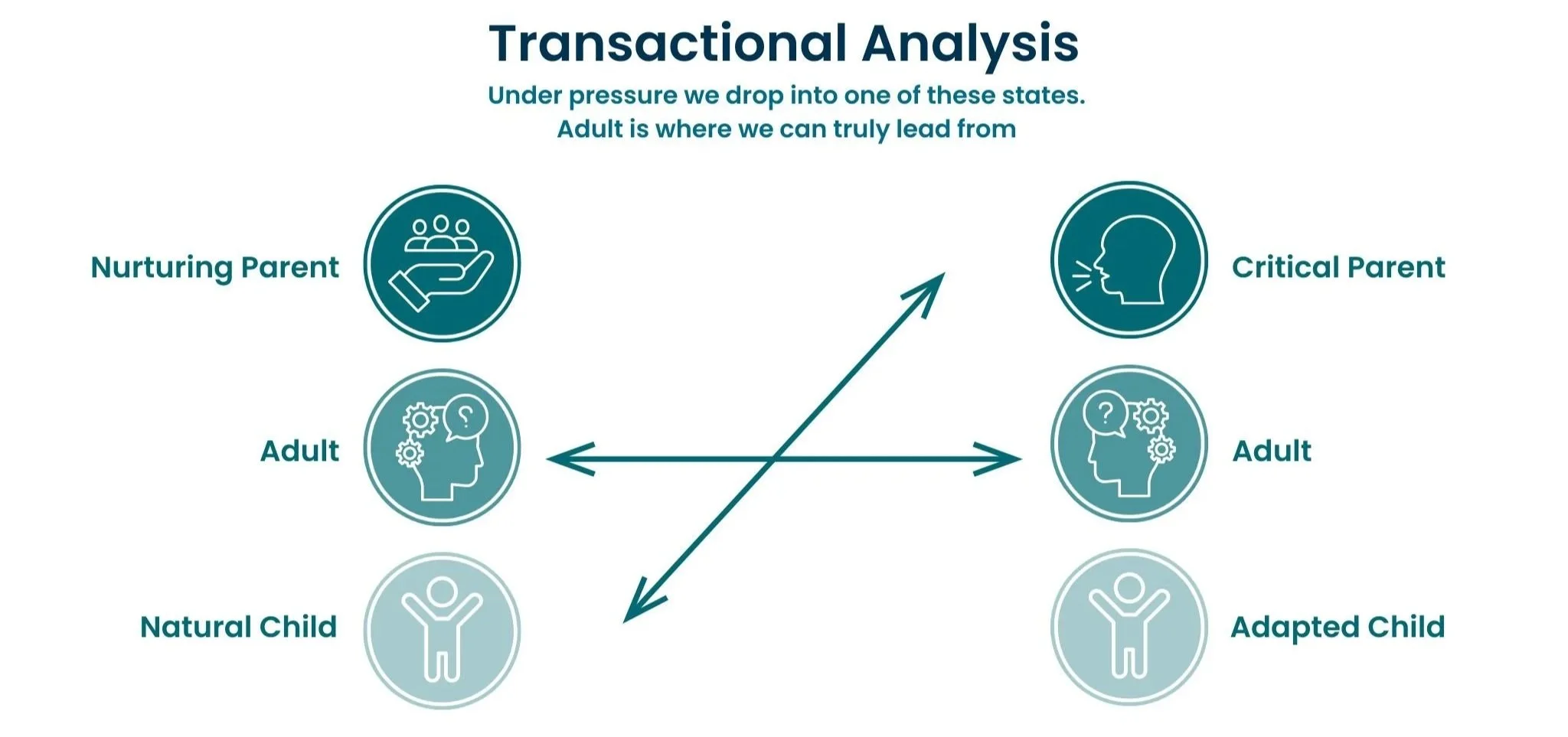
Layer one. This is where transactional analysis comes in, and specifically Eric Berne's parent-adult-child model. Under pressure most of us drop into one of a few states without noticing.
Critical parent shows up as judgement and rules, the "you should have" and "why haven't you". Nurturing parent shows up as care, sometimes as over-care. Then there are the child states spontaneous people-pleasing, depending on what kept us safe long before this meeting. Adult is where you want to be under pressure. Calm, curious, responding to what's in front of you rather than a script left over from years ago. I'm not sure many of us manage to stay there for long.
Now back to that question. There's a difference between a manager consciously softening their style and one whose frustration is quietly leaking out through the soft words. The words come out supportive. "Don't worry, I'll take that off your plate." "Just checking in on how you're getting on." "Let me have a look, save you the stress."
On paper that's kindness. In practice the person on the receiving end usually feels smaller and more anxious. Underneath the soft language sits a message that's pure critical parent. "I don't trust you to do this without me."
The gap between the words and the impact is the tell. We're good at picking it up even when we can't name it.
So what do you do if you’re on the receiving end? Name the experience, not the behaviour. Steer clear of "you're being controlling", which is an accusation and pulls everyone into a scrap. Try something closer to "when that happens, it feels quite parental to me". That small sentence moves the conversation from parent-child, where somebody has to win, into adult-adult, where two people can look at what's happening and sort it out.
Your beliefs
Layer two. That ego state didn't appear from thin air. It comes from somewhere.
Underneath is a more subtle question. How do I see myself in relation to you right now? Thomas Harris gave us four positions for this. I'm OK, you're OK, which is mutual respect and the healthiest place to work from. I'm OK, you're not OK, which is "I know better than you". I'm not OK, you're OK, which is "everyone else has it more together than me". And I'm not OK, you're not OK, which is "nobody's really coping, so what's the point". Most of us move between these depending on the day, the person, and how much sleep we've had.
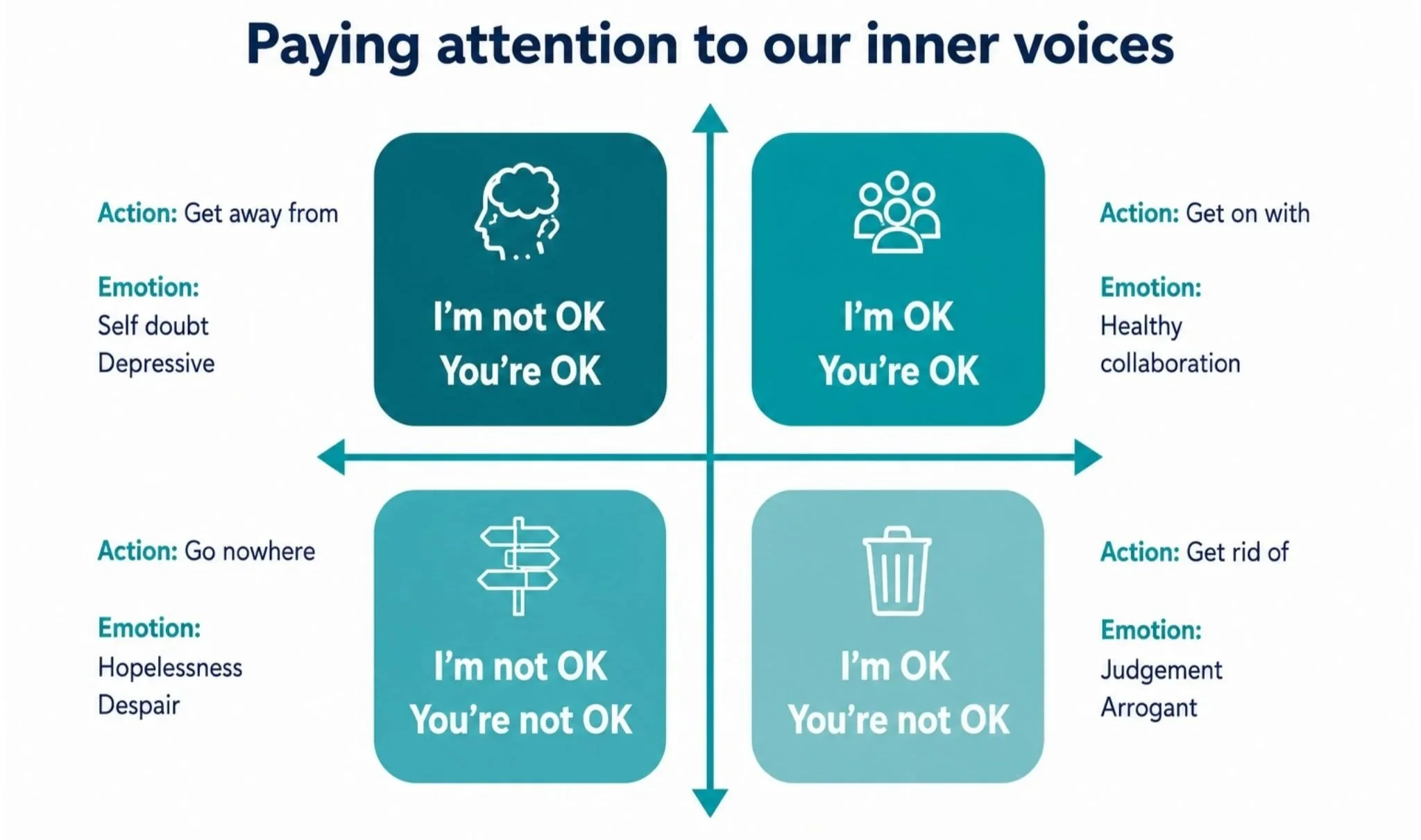
The nurturing-parent-in-disguise almost always comes from "I'm OK, you're not OK". I know better, so I'll take care of this for you. And here's the sneaky bit. From the inside it rarely feels like arrogance. It feels like care. That's what makes it so hard to spot in yourself, and harder still to challenge in someone else. I've been there myself, and I've written before about the toxic leader I didn't know I'd become.
So the belief shapes the state. "I know better than you" is what tips a manager into taking over instead of trusting.
Your behaviours
Layer three. Go one more step and you reach what everybody sees. The behaviour.
Stephen Karpman's drama triangle has three roles. Victim, persecutor and rescuer. Our manager from earlier, the one who knows better and dresses criticism up as care, is usually playing rescuer.
And rescuers need someone to rescue. Which means, usually without either person clocking it, the "help" quietly needs the other person to keep needing it. That's why well-meant oversight so often keeps someone exactly where they are instead of growing them out of it. The manager doesn't want to hold anyone back. The roles have just locked into place and nobody's named it. It's a good example of the shadow you cast as a leader without ever meaning to.
The chain behind the behaviour
Pull the three layers together and it's clear once you see it. The belief "I'm OK, you're not OK" tips you into nurturing-parent-as-critical-parent, and that drops you into the rescuer role. The behaviour everyone reacts to at the end started as a belief nobody ever said out loud.
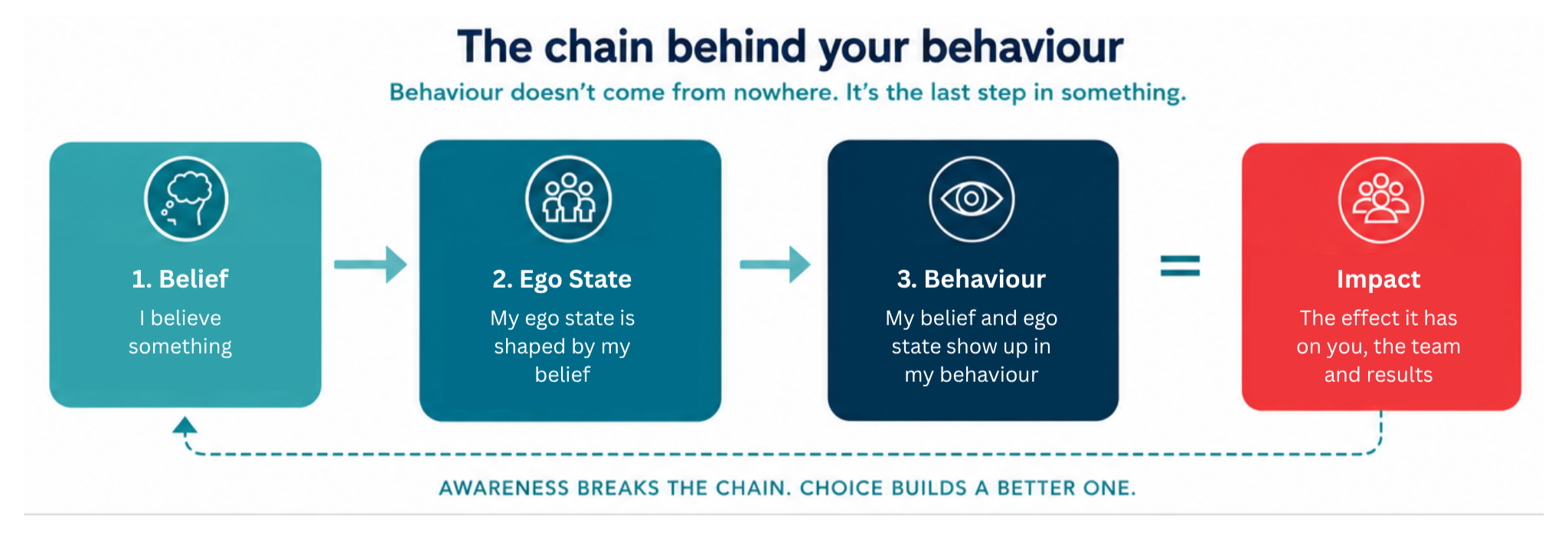
So when you want to shift a behaviour, yours or someone else's, prodding the behaviour on its own rarely works. You have to trace it back to the state it came from, and the belief underneath that. This is what I mean when I say everything deserves diagnosis.
Why this matters for your team
A team can score beautifully on a DISC exercise and still be stuck, because none of that touches what happens under real pressure.
There are two ways I'd help with something like this, and they do different jobs.
A Team Diagnostic is the outside-in look. I come in, ask the questions a survey never quite reaches, and give you back a clear read on what's going on and the one thing worth fixing first. The "my manager is too supportive" problem almost never surfaces in an engagement survey, because people can't put it into words. A diagnostic gives it words.
A Team Tune-Up is where the team does the work together. It's an offsite built around self, impact and choice. How I show up under pressure, what that does to the people around me, and what we decide to do differently once we can see it. It's the naming-then-choosing part, done in the room as a team.
So the diagnostic helps you see the pattern, and the tune-up helps the team change it. You can't choose your way out of something you haven't named.
If any of this sounds familiar, as the manager or the person on the receiving end, it's worth a proper conversation before it becomes the reason a good team quietly underperforms.
Not sure which you need? Book a free consultation call, and we'll work out where to start.